28 FAIR Data Analysis
28.1 Introduction
Bioinformatics is not only about data analysis, but also about how data are managed, shared, and reused responsibly, an approach now widely known as the FAIR Data Principles (Wilkinson et al. 2016; Rocca-Serra et al. 2023). Before exploring this topic in greater depth, we need to understand two fundamental concepts that form the foundation of modern bioinformatics research practice: (1) Research Data Lifecycle and (2) Open Science.
28.2 Research Data Lifecycle
The Research Data Lifecycle describes the journey of data throughout a research project, beginning from the planning stage and continuing until the data can be reused by other researchers.
The following are the main stages in the research data lifecycle:

The Research Data Lifecycle begins with the planning and research design stage. In this phase, researchers prepare a Data Management Plan (DMP), determine the data and metadata formats to be used, consider ethical aspects, and design strategies for data storage and publication. Careful planning at this stage facilitates effective data management throughout the subsequent phases.
The next stage is data collection, for example through sequencing processes and metadata acquisition, which generate raw data such as FASTQ or BAM files. These raw data then enter the processing and analysis stage, which includes quality control, trimming, assembly or alignment, annotation, statistical analysis, and data visualization. At this stage, the principle of reproducibility becomes essential to ensure that the research can be verified and repeated by other researchers.
Once the analysis is complete, both the data and research outputs are published through scientific articles and deposited in public repositories that provide a digital object identifier (DOI) and open access. To ensure long-term availability, data should be preserved in non-proprietary formats and stored in reliable storage systems.
Ultimately, well-published and properly preserved data can be reused for various purposes, such as meta-analysis, algorithm benchmarking, or the development of machine learning models. In this way, the Research Data Lifecycle emphasizes that research data do not end with a single publication, but can continue to generate scientific value over time.
28.3 Open Science
Open Science is a movement that aims to make scientific research (whether in the form of publications, software development, or data) openly accessible to all levels of society. Its core principles are transparency, accessibility, and collaboration. Scientific knowledge is no longer treated as closed or exclusive, but instead is widely shared so that it can be used, verified, and further developed collectively.
In practice, Open Science encompasses several important aspects, including:
- Open Access – Scientific publications are accessible without a paywall. This includes preprints, which allow researchers to openly share their findings before undergoing the peer review process.
- Open Data – Research data are available for download and reanalysis.
- Open Source – Code and software are openly shared.
- Open Methodology – Methods and analytical workflows are described transparently.
- Open Peer Review – The peer review process is conducted in a more transparent and open manner.
In the context of bioinformatics, Open Science plays a crucial role. Genomic, transcriptomic, and metagenomic analyses often involve large datasets and complex computational pipelines. By sharing raw data, analysis scripts (for example via GitHub or GitLab), and the parameters used, other researchers can reproduce the results, validate findings, or even develop new approaches using the same data.
Furthermore, Open Science fosters the development of global collaborative networks. Public datasets deposited in international repositories can be accessed and utilized by researchers from different countries to address new scientific questions. This accelerates scientific progress while also enhancing accountability and trust in research outcomes.
28.4 Licensing in Open Science
In the practice of Open Science, licensing plays a crucial role because it determines how scholarly works; whether publications, data, or software; may be reused by others. One of the most commonly used licensing systems is Creative Commons (CC). Beyond Creative Commons, the Open Science ecosystem also includes various open-source software licenses such as the MIT License, GNU GPL (General Public License), and GNU AGPL (Affero General Public License). These licenses provide a standardized framework for developers or creators to grant the public permission to use their work under specific conditions.
In this practicum, you will often act as a reuser of various datasets and bioinformatics software developed by others. From this perspective, it is essential to understand the licenses associated with the data and software you use, and to always ask: “What am I allowed to do with this data, software, or work?”
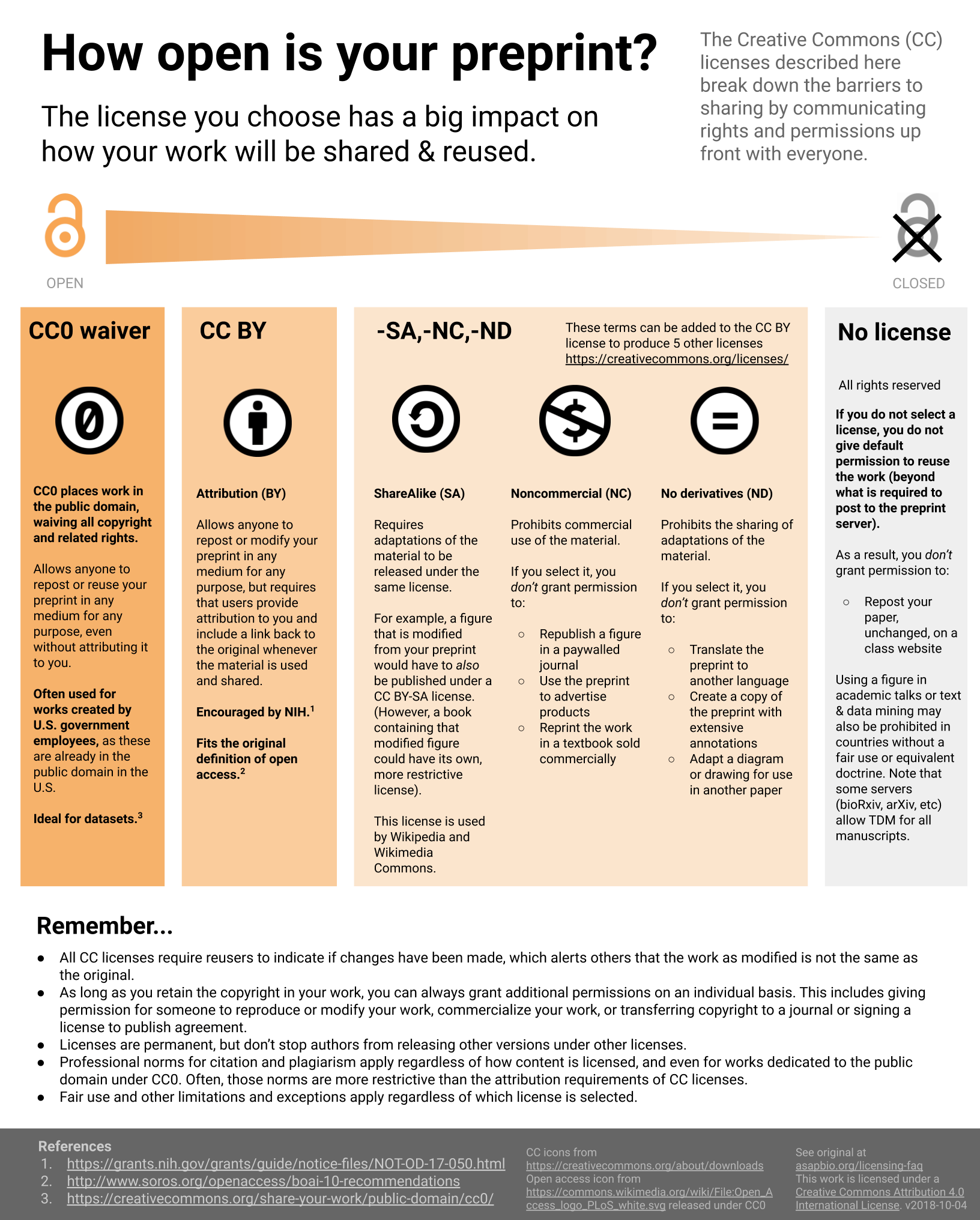
In the future, if you are interested in becoming a software developer or generating your own research data, you will also need to carefully consider which license to apply to your work. The choice of license should align with your goals for sharing. Do you want your work to be used commercially? Do you allow modifications? Do you want derivative works to remain open? These questions will help you determine the most appropriate license.
If you would like to explore licensing options further, you can try the CC License Chooser at the following website: https://creativecommons.org/chooser/
Before applying a license, consider the following important points:
- CC licenses and CC0 are irrevocable once applied.
- Only the copyright holder can apply a license.
- If the work is created within the scope of institutional employment (for example, as a student or researcher at Universitas Gadjah Mada), the copyright may belong to the institution rather than the individual.
28.5 FAIR Data Principles

FAIR is an acronym for Findable, Accessible, Interoperable, and Reusable. These principles serve as high-level guiding principles for research data management, ensuring that data are properly organized and remain valuable over the long term.
- Findable. Data should be easy to locate, for example by using unique identifiers (such as DOIs or accession numbers) and clear, standardized metadata.
- Accessible. Data should be retrievable using the identifier through well-defined protocols. Access may be open or may require authorization, depending on the sensitivity of the data.
- Interoperable. Data should be structured using shared formats, vocabularies, and ontologies so that they can be integrated with or compared to other datasets.
- Reusable. Data should be well described, comply with community standards, and include a clear usage license to enable reuse for different purposes.
In bioinformatics, the FAIR principles are particularly important because datasets are often large-scale and complex (frequently in the form of continuously growing databases). By providing sufficient description and context, adopting widely accepted community standards (such as FASTQ, BAM, or GFF formats), and sharing data appropriately, other researchers can find, access, integrate, and reuse these datasets without significant barriers.
28.6 FAIR vs Open
Although often associated with Open Science, FAIR does not necessarily mean “open.” FAIR refers to a set of principles describing how data are managed and described, whereas open refers to the level of access and availability.
A dataset can be FAIR without being fully open to the public. For example, within an institution, data can be made findable, accessible, interoperable, and reusable for members of the organization, while not being openly shared with the broader international community.
Regulatory and ethical considerations also play an important role. Datasets containing personally identifiable information or derived from human subjects may require stricter access controls. Such data can still comply with the FAIR principles (by providing clear metadata, controlled access mechanisms, standard formats, and appropriate licensing) while being accessible only under specific conditions in accordance with applicable regulations. One example is human Whole Genome Sequencing data generated by national initiatives such as BGSI and the Ministry of Health.